
by David W. Brown Middletown, RI July 2025
Member of the Navy Newport Restoration Advisory Board (RAB) since its formation in 1995
and Community Co-chair of the RAB 2016-21
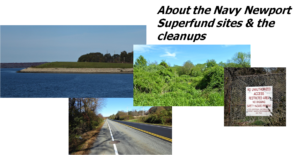
Besides the unique vistas, boating events, mansions and histories in and near Newport RI, our seaside areas have been key sites for U.S. Navy ship bases, training and R&D. But Navy needs left behind contaminated clutter in some spots: dumps that contained God knows what … huge ship-fuel tanks and miles of pipelines with oil sludge … remains of hydraulic pumps, fire-fighting fluids and electrical gear … buildings and shore areas with asbestos, lead, arsenic and other stuff now known to be unsafe to people.
Especially since the 1990s, there have been Federal and state mandates, and modest funds, to remove or bury safely such contaminants, so that these areas can be re-used or at least not endanger nearby lives. The Navy has teams of experienced environmental specialists and contractors who come here to identify where the most serious contaminants are, and to plan and monitor the cleanups. They work closely with counterparts from the Environmental Protection Agency, the RI Department of Environmental Management, and health-related agencies. These specialists don’t just sit in the comforts of their home offices; much of their work is out there on the actual sites, sloshing around in boots, toting equipment, digging beneath the surfaces, taking measurements, and shaping plans about which spots to attend to first, and in what ways.
Restoration Advisory Boards (RABs) have been created to enable nearby residents, leaders, officials and news media to meet with these specialists to learn what contaminants are being found, and what remedies are proposed, These local RAB members help to spread this information to nearby neighborhoods and other key groups. They help fashion the cleanups to mesh better with adjacent land-use patterns and plans, water flows and life qualities. Local old-timers at RAB meetings have helped the specialists to know what contaminants have been left where.
The Restoration Advisory Board for Naval Station Newport has been one of the most productive RABs in the region. Our RAB meets every two months in a convenient motel conference room. Those of us who can’t be there in person can “look in” by internet or phone. Each meeting has updates and a special briefing blended with opportunities to ask questions, offer suggestions, and add information. Rather than win-lose debates or tricky talk tactics, emphasis is on constructive, focused yet relaxed interactions between locals and the specialists.
The RAB has been one of my most fulfilling “causes”. Genuine friendships among capable, well motivated people are formed at our RAB meetings. To take part in these two-hour sessions is a great way for a budding citizen-leader to gain experience in civic interactions. And for a young professional to learn first-hand the ins-and-outs of what environmental cleanup specialists do. And for a town official or commission member to mesh with the Navy about what can best happen along the west coast of Newport, Middletown or Portsmouth, or on Jamestown’s Gould Island.
The current Community Co-chairman is Henry Stueber, a retired Navy officer who lives in Newport and well understands neighborhood and shore-area concerns, email hbstueber@comcast.net. The Navy Co-chairman, David Dorocz, has long experience as Environmental Director for Naval Station Newport, email david.d.dorocz.civ@us.navy.mil.
It takes a long time to pinpoint contaminants, weigh cleanup options, and complete the work. Along the way, new concerns have shown up — PFAS in soil and water near former fire-suppression systems … a few spots that may still have live munitions lurking. There is now more awareness of need to take into account the climate-related changes in our shore lines and storm-water runoffs. But for the most urgent of the cleanup needs, the end seems in sight these next few years.
In this web page I have brought together more details about the Navy Newport sites and recent examples of what we learn and do at our Restoration Advisory Board meetings.
Here is the Navy’s website about the Environmental Restoration Program at Naval Station Newport.
And Site Descriptions of the tank farms, land fills, pier areas, etc.
They include a useful map and summaries of the histories of the sites needing attention — previous uses by the Navy, contaminants found, cleanups thus far. Most of the sites are along “Burma Road” on the western side of Aquidneck Island. One is at the North end of Gould Island, near Jamestown. Recently a couple of new sites not directly Navy’s have been added.
Here is background about the roles and standards of EPA and RIDEM specialists in this work.
And here are two reliable sources about human health hazards of site contaminants:
U.S. Dept of Health ATSDR (Agency for Toxic Substances and Disease Registry) Specialists and MDs from ATSDR provided level-headed assessments and explanations.
Rhode Island Dept of Health, Environmental Health Risk Assessment Program Many links to others. Includes attention to PFAS.
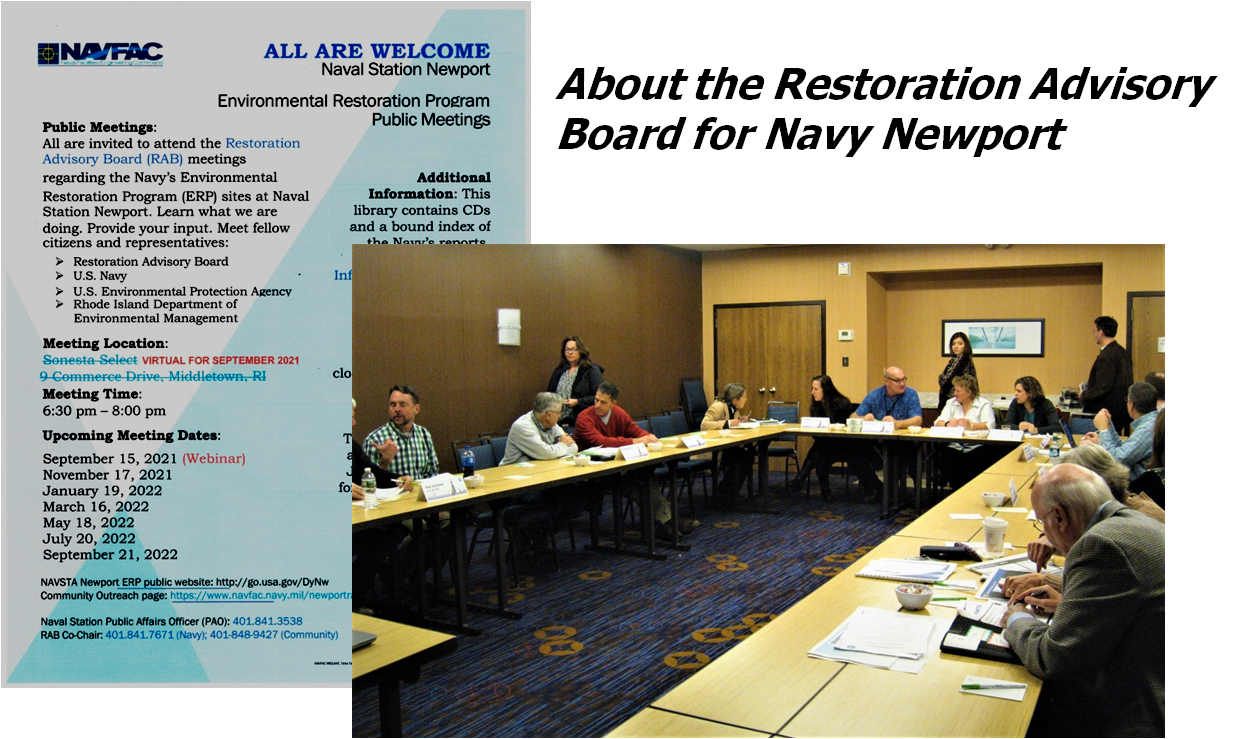
Our Navy Newport Restoration Advisory Board meetings center around 1) updates of studies, decisions and actions for all the sites, then 2) we have a briefing and discussion about a specific site or aspect.
For example, at our July 2025 RAB meeting, we followed this agenda:
… reviewed and accepted the previous meeting’s minutes
… learned about and discussed the latest steps toward cleaning up each site
… and saw overall progress via a Milestone Chart.
… Then we focused on the meeting’s special technical presentation — clarification of the careful work needed to assess human-health and environmental risks on locations of special concern.